

















Why do you say "il mio gatto" but not "la mia madre" in Italian?

This is one of those things in the Italian language that either you’re a native speaker or you’ll struggle with.
Sometimes, native people use grammar rules correctly without even knowing they’re grammar rules—they just come natural to them. To answer this question, I myself had to look it up in my old grammar books.
And the answer was easier than I thought:
In a grammatically correct Italian you always have to say “the” (il, la, gli, le) before a possessive adjective like my, your, his, her (mio, tuo, suo…) or you’ll end up sounding like Tarzan.
Let's see an example:
Tarzan would say: "mio gatto mangiare crocchette" (notice that there's no "the" before mio). This is wrong ✖️
A native Italian would say: "IL mio gatto mangia crocchette". This is correct ✔️
Exception
But this is Italian we’re talking about, it can’t be that easy! There are exceptions, of course: mother is one of those. The other ones are:
Padre (father)
Fratello/Sorella (brother/sister)
Zio/Zia (uncle/aunt)
Nonno/Nonna (grandmother/grandfather)
Nipote (niece/nephew)
Cugino/Cugina (cousin)
Marito/Moglie (husband/wife)
Figlio/Figlia (son/daughter)
Suocero/Suocera (mother-in-law/father-in-law)
Genero/Nuora (son-in-law/daughter-in-law)
Cognato/Cognata (brother-in-law/sister-in-law)
So really, all family names used in their singular form are exceptions and DO NOT want “the” (il, la) before.
Mio nonno ✔️
IL mio nonno ✖️
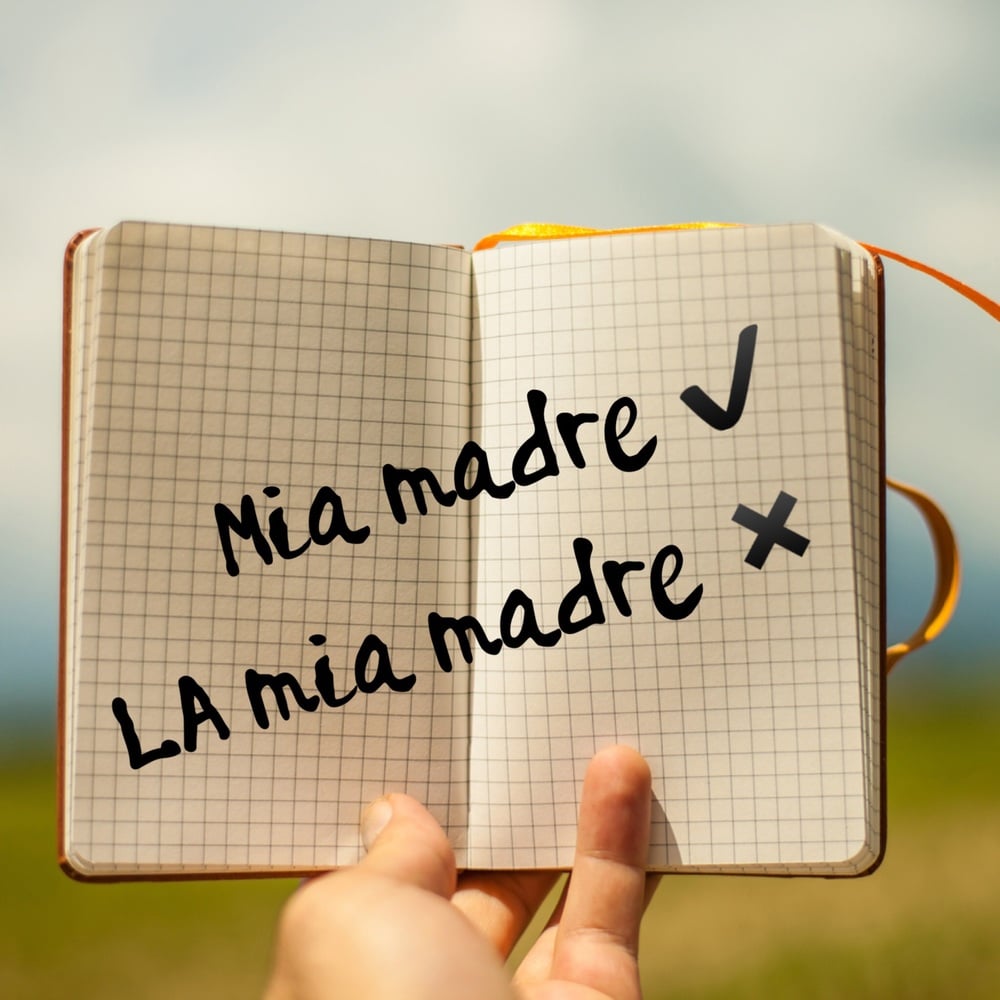
Mia madre ✔️
LA mia madre ✖️
Did you like it? Click the heart, share it or leave a comment :-)You can do it here.